ICF Wall System
ICF Wall System: A Complete Building Solution for Modern Construction
An ICF Wall System (Insulated Concrete Form Wall System) combines insulated formwork, reinforced concrete and construction alignment equipment into one integrated wall-building method.
Instead of constructing a wall through multiple traditional processes, ICF construction uses lightweight insulating forms to create the wall shape. Reinforcing steel is then installed inside the form, followed by concrete placement.
After the concrete cures, the result is a reinforced concrete wall surrounded by continuous insulation.
The basic concept is:
ICF Forms + Reinforcement + Concrete + ICF Bracing + Finishing = Complete ICF Wall System
For builders, contractors, developers and distributors, the value of ICF is therefore not simply the foam block itself.
The complete system can provide a combination of:
Thermal insulation
Structural concrete
Construction efficiency
Wall alignment
Reduced construction stages
Moisture resistance
Fire-performance characteristics
Flexible wall configurations
Long-term building-envelope performance
Sunforest develops and supplies ICF wall systems for international construction markets, including North America, Europe, Australia, the Middle East and Asia.
What Is an ICF Wall System?
ICF stands for:
Insulated Concrete Forms
An ICF wall normally consists of two insulating form panels connected by internal webs or inserts.
The basic construction sequence is:
1. Assemble ICF forms
↓
2. Install reinforcing steel
↓
3. Install openings, embeds and services
↓
4. Install ICF bracing
↓
5. Align and plumb the wall
↓
6. Place concrete
↓
7. Allow the concrete to cure
↓
8. Apply interior and exterior finishes
The ICF forms remain in place after concrete placement and become part of the building envelope.
This creates a wall system where the structural concrete core and insulation work together.
The Main Components of an ICF Wall System
A professional ICF wall system is more than an individual block.
1. ICF Wall Forms
The ICF forms create the shape of the wall and provide insulation around the concrete core.
Different configurations can be used for:
Straight walls
Corners
T-junctions
Openings
End walls
Special architectural structures
Sunforest provides different ICF configurations according to wall thickness, concrete core requirements and project design.
2. Reinforced Concrete Core
After the ICF forms are assembled and reinforced, concrete is placed into the cavity.
The reinforced concrete core provides the primary structural mass of the wall.
The required:
Concrete thickness
Reinforcement
Concrete strength
Vertical reinforcement
Horizontal reinforcement
Connections
should be determined according to the structural design and applicable local building codes.
This is particularly important for projects in regions with high wind or seismic loads.
3. ICF Bracing and Alignment System
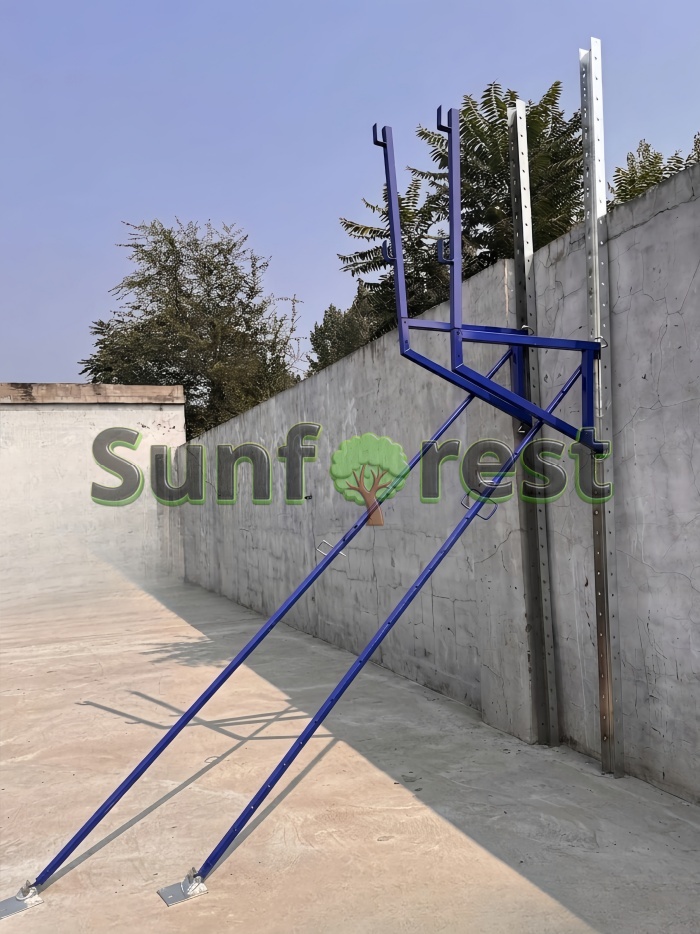
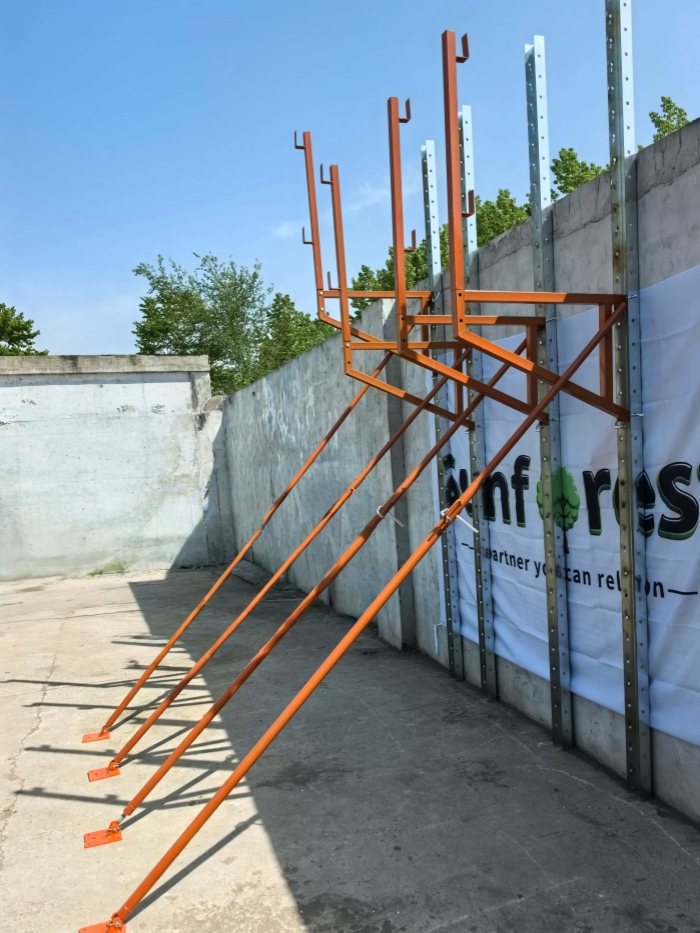
ICF bracing is an essential part of the construction process.
Before and during concrete placement, the ICF wall needs to remain:
Straight
Plumb
Properly positioned
Structurally supported
Sunforest therefore develops and manufactures dedicated ICF Bracing Systems.
Our ICF bracing can provide:
Wall Support + Alignment + Plumbing + Working Platform
This allows contractors to adjust the wall before the concrete sets.
For an ICF contractor, the difference between simply assembling blocks and controlling the entire wall system can have a major impact on the final construction quality.
Why ICF Bracing Is Important
A wall can contain high-quality ICF forms and concrete, but if the wall is not properly aligned during construction, additional corrective work may be required.
Professional ICF bracing helps contractors control:
Wall Plumb
Adjust the wall vertically.
Wall Alignment
Keep long wall sections straight.
Wall Support
Provide temporary support during concrete placement.
Working Platform
Provide a practical working area for construction operations, depending on the bracing configuration.
Construction Efficiency
Allow workers to adjust and check the wall during installation rather than correcting problems later.
This is why Sunforest considers ICF + ICF Bracing a coordinated system rather than two unrelated products.
4. Reinforcement
Reinforcing steel is installed inside the ICF cavity according to the structural design.
Depending on the project, reinforcement can include:
Vertical rebar
Horizontal rebar
Corner reinforcement
Opening reinforcement
Structural connections
The reinforcement design should be completed by the project's structural engineer according to local requirements.
For seismic regions, hurricane-prone areas and buildings with higher structural loads, engineering design becomes particularly important.
5. Concrete Placement
Concrete placement is one of the most important stages of ICF construction.
The concrete needs to be placed in a controlled sequence to avoid excessive pressure on the forms.
Sunforest's construction experience recommends controlled concrete placement rather than simply filling the wall as quickly as possible.
The exact:
Pour height
Pour rate
Concrete mix
Slump
Vibration method
Wall configuration
should be determined according to the project conditions and applicable requirements.
This is another reason professional ICF bracing and alignment are important.
6. Interior and Exterior Finishes
After the concrete core is completed, the ICF wall can receive suitable interior and exterior finishes.
Depending on the project, these can include:
Render
Mortar
Stucco
Plaster
Drywall systems
Cladding
Other approved finishing systems
The ICF surface profile is designed to provide mechanical engagement with appropriate finishing materials.
The final finish should always be selected according to local climate, building regulations and the specific finishing manufacturer's requirements.
Sunforest High-Density ICF: 30kg/m³
One of Sunforest's ICF product focuses is high-density ICF.
A tested Sunforest white straight ICF sample measuring:
900 × 300 × 250 mm
had a reported apparent density of:
30 kg/m³
The laboratory test report recorded:
Thermal Conductivity: 0.033 W/(m·K)
and:
Compressive Strength: 161 kPa
The report assessed the tested sample as qualified against its stated requirements.
Thermal Insulation of the ICF Wall System
Thermal insulation is one of the most important reasons builders choose ICF.
The tested Sunforest ICF material recorded:
λ = 0.033 W/(m·K)
This is a relatively low thermal conductivity value.
For customers familiar with the North American R-value system, the material-level conversion is approximately:
R-4.37 per inch
This conversion represents the thermal resistance of the tested insulating material based on its thermal conductivity.
It should not be interpreted as the final R-value of the complete ICF wall.
The actual wall R-value depends on:
Insulation thickness
Concrete core
Web configuration
Thermal bridges
Wall geometry
Openings
Interior finish
Exterior finish
Installation details
For project-specific energy calculations, the complete wall assembly should be evaluated.
ICF for Cold Climates
In cold climates, a major challenge is:
Heat escaping from the building.
A continuously insulated ICF wall can reduce conductive heat transfer through the wall assembly.
This can help support:
Indoor temperature stability
Reduced heating demand
Improved thermal comfort
Better building-envelope performance
ICF is therefore suitable for projects in climates such as:
Northern Europe
Canada
Northern United States
Northern China
Cold regions of Australia
ICF for Hot Climates
In hot climates, the challenge is reversed:
Heat entering the building.
The insulated ICF wall can slow heat transfer from the exterior into the building.
This makes ICF particularly relevant to:
Southern Europe
Mediterranean regions
Middle East
Australia
Southern United States
Southeast Asia
For buildings where air conditioning represents a significant operating cost, improving the building envelope can be an important part of the overall energy strategy.
One Wall System for Hot and Cold Climates
This is one of the most important characteristics of ICF.
The insulation works in both directions.
Winter
Reduce heat loss
Summer
Reduce heat gain
The result is a building envelope designed to help maintain more stable indoor conditions throughout the year.
Sunforest therefore supplies ICF solutions for projects ranging from cold-climate residential buildings to high-temperature Middle Eastern and tropical construction projects.
ICF Wall System for Europe
European construction is increasingly focused on:
Energy efficiency
Building-envelope performance
Reduced energy consumption
Low-carbon construction
Long-term operating costs
ICF can support these goals by combining continuous insulation with a reinforced concrete wall.
Sunforest has supplied ICF products to European customers, including 350mm graphene ICF and Split Type Graphene ICF configurations.
For projects requiring high insulation performance, thicker ICF configurations can be considered according to the project's energy-performance requirements.
ICF Wall System for North America
ICF has long been used in North American residential and commercial construction.
Typical applications include:
Single-family homes
Multi-family buildings
Basements
Retaining-related structures
Storm-resistant buildings
Commercial buildings
Schools
Small institutional buildings
Sunforest supplies ICF products and dedicated bracing systems to customers in the United States and Canada.
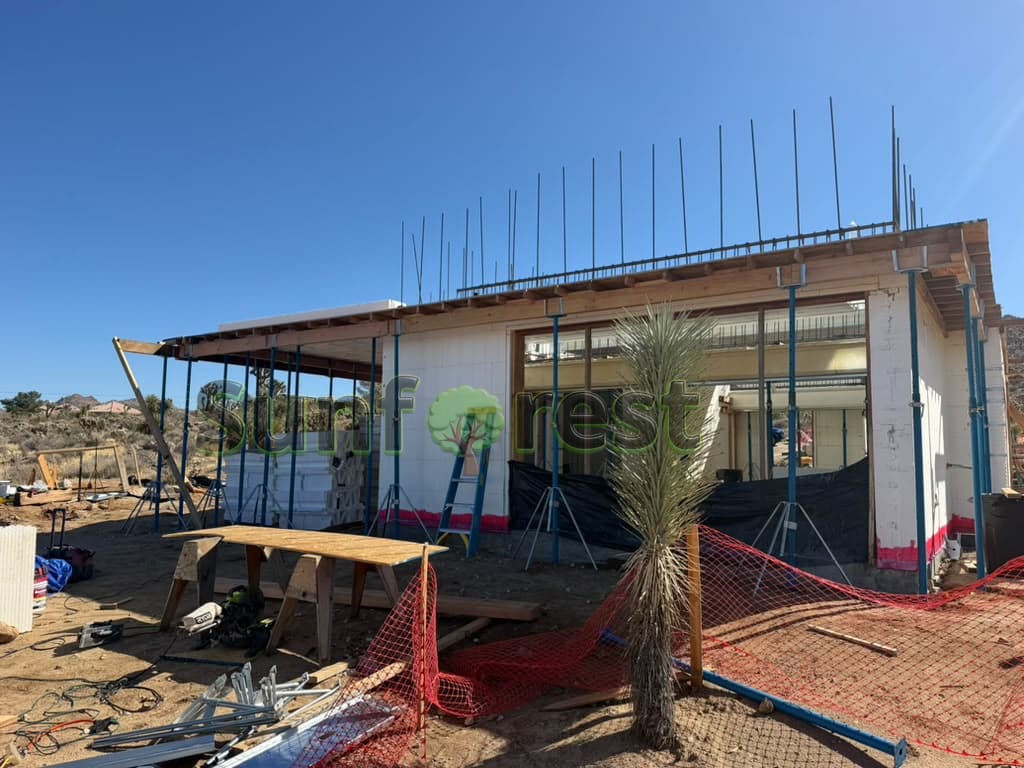
A recent project in Los Angeles involved a customer using Sunforest ICF, ICF bracing, shoring posts, steel planks and other construction products to build a small demonstration and testing structure.
This allowed the customer to gain practical experience with ICF construction before expanding into larger projects.
ICF Wall System for Australia
Australian construction can involve demanding combinations of:
High summer temperatures
Strong solar exposure
High labor costs
Energy-efficiency requirements
Long-term durability requirements
Sunforest supplies ICF and customized ICF bracing systems to Australian customers.
Our Foldable ICF Bracing has also been customized for Australian applications, with engineering drawings and surface-treatment options available according to project requirements.
ICF Wall System for the Middle East
The Middle East presents a very different construction environment.
Summer temperatures can be extremely high, while cooling demand can be significant.
For these projects, the building envelope becomes particularly important.
ICF can provide:
Insulation + Concrete Structure + Fast Construction
in one wall system.
Sunforest can also provide different ICF bracing surface treatments depending on the environment, including:
Hot-Dip Galvanized
Electro-Galvanized
Painted
Powder Coated
Self-Color
For long-term outdoor exposure and highly corrosive environments, hot-dip galvanizing can be considered.
ICF Wall System for Southeast Asia
Southeast Asia combines several challenging conditions:
High temperature
High humidity
Heavy rainfall
Tropical climate
Labor requirements
Seismic activity in some regions
ICF can be attractive because it combines an insulated wall with a reinforced concrete structural core.
This makes it particularly interesting for:
Residential buildings
Resorts
Villas
Hotels
Tropical housing
Seismic-region construction
However, seismic design, waterproofing, drainage and reinforcement must always be engineered for the specific project and local regulations.
Split Type ICF: Designed for International Transportation
One of Sunforest's product developments is the Split Type ICF.
Traditional one-piece ICF forms occupy significant container volume because the two insulation panels and internal connectors remain assembled.
Sunforest's Split Type ICF separates the:
ICF Panels + Internal Inserts
during transportation.
This significantly reduces shipping volume.
For example, using the commonly ordered:
900 × 280 × 300 mm Straight Block
Sunforest's current packing calculation can reach approximately:
490㎡ per 40HC container
and approximately:
220㎡ per 20ft container
depending on packing configuration.
This can significantly improve international logistics efficiency compared with conventional one-piece ICF packing.
Why Split Type ICF Can Reduce Total Project Cost
The advantage is not only the factory price.
Reducing shipping volume can affect:
Ocean freight per square meter
Container utilization
Local warehousing
Handling
Transportation
Inventory requirements
This is particularly valuable for ICF distributors and contractors importing from China.
Instead of optimizing only:
Cost per Block
Sunforest focuses on:
Total Landed Cost per m²
This is an important distinction for international construction-material sourcing.
Flexible Concrete Core Thickness
Another advantage of the Split Type ICF concept is flexibility.
Sunforest can provide different internal inserts for different concrete-core requirements.
For common applications, full-plastic inserts can be used for configurations such as:
140mm / 170mm concrete core
For applications requiring thicker concrete cores, such as:
Foundations
Basements
Heavy-duty walls
Special structural applications
Sunforest can also develop inserts for:
200mm / 250mm
and special configurations such as:
500mm / 1000mm
according to engineering requirements.
For thicker applications, Sunforest uses combinations of 6mm threaded steel reinforcement and virgin PP plastic in the insert structure.
The exact insert configuration should be selected according to the structural design and project requirements.
Flexible ICF Configuration
Sunforest's Split Type ICF system is designed so that the same basic insert concept can be used across different block configurations.
For example:
Straight Block
and
Corner Block
can use corresponding inserts with different lengths.
This allows contractors to adapt wall configurations on site without maintaining excessive inventories of different complete ICF blocks.
For distributors, this can also simplify SKU management.
350mm ICF for High-Performance Building Envelopes
For regions with extreme temperatures, thicker ICF walls can provide additional insulation thickness.
Sunforest has developed and exported 350mm Graphene ICF products for international projects.
The thicker wall configuration is particularly relevant to:
Cold climates
Hot climates
High-performance residential buildings
Energy-efficient projects
Projects requiring greater insulation thickness
Sunforest is also developing a 350mm Split Type Graphene ICF solution to improve transportation efficiency.
This reflects an important part of Sunforest's product-development strategy:
We do not only manufacture existing ICF products. We continue developing new configurations based on international customers' construction and logistics requirements.
ICF Construction Speed
One of the practical advantages of ICF is construction efficiency.
Based on Sunforest's construction experience, a building of approximately:
100㎡
can potentially reach the main structural stage with:
4–5 workers
in approximately:
12–15 days
depending on:
Building design
Wall configuration
Worker experience
Concrete supply
Weather
Site conditions
Reinforcement requirements
Compared with traditional multi-stage wall construction, ICF can simplify the workflow by combining formwork and insulation into one system.
Lower Labor Requirements
Labor is a major consideration for construction companies in:
United States
Canada
Europe
Australia
Middle East
Traditional construction can require several different trades and multiple construction stages.
ICF construction can simplify the wall-building process.
Workers need proper training, but the repetitive installation process can be learned relatively quickly.
For contractors dealing with high labor costs or skilled-labor shortages, this can be an important economic advantage.
ICF Wall System and Structural Strength
The completed ICF wall contains a reinforced concrete core.
This provides a fundamentally different structural approach from conventional lightweight partition walls.
The final structural performance depends on:
Concrete strength
Wall thickness
Reinforcement
Building height
Openings
Connections
Foundation
Wind loads
Seismic loads
Local structural codes
Sunforest's tested ICF sample recorded:
161 kPa compressive strength
and:
0.10 MPa vertical tensile strength
against the stated test requirements.
The foam test itself does not establish the structural capacity of the completed reinforced-concrete building. That must be determined through project-specific structural engineering.
ICF for Seismic Construction
ICF can be particularly attractive for seismic regions because the completed wall incorporates reinforced concrete.
Potential application markets include:
Japan
Southeast Asia
Indonesia
Parts of China
Western North America
Other earthquake-prone regions
However, ICF does not automatically make a building earthquake-proof.
The structural engineer must determine:
Rebar size
Rebar spacing
Concrete strength
Wall thickness
Connections
Openings
Foundation
Lateral-load system
according to the applicable seismic code.
Sunforest provides the ICF wall components; the structural design must be completed according to the project's engineering requirements.
Moisture and Water Absorption
The tested Sunforest ICF sample recorded:
Water Absorption: 0.9%
against a stated requirement of ≤2%.
The low measured water absorption supports the material's suitability as an insulating form material.
However, complete wall moisture performance also depends on:
Exterior finish
Waterproofing
Flashing
Drainage
Roof design
Openings
Local climate
ICF should therefore be considered as part of the complete building envelope rather than as a standalone waterproofing system.
Fire Performance
The supplied laboratory report recorded:
Oxygen Index ≥30
and a reported:
B1(C) fire-performance classification
The sample was assessed as qualified according to the report's stated requirements.
For finished buildings, fire performance depends on the complete wall assembly, including:
Concrete
ICF insulation
Interior finish
Exterior finish
Fire barriers
Penetrations
Building configuration
For export projects, local fire regulations and the applicable European, North American, Australian or other national classification systems must be separately evaluated.
Dimensional Stability
The tested sample recorded approximately:
0.9% dimensional stability
for length, width and thickness against the stated ≤2% requirement.
Dimensional stability is particularly relevant to ICF construction because the blocks need to maintain their intended geometry during:
Storage
Transportation
Assembly
Reinforcement installation
Concrete placement
Combined with appropriate bracing, stable ICF dimensions can contribute to more predictable wall installation.
Sunforest ICF Wall System: Product + Engineering + Supply Chain
Sunforest's approach is different from simply selling ICF blocks.
We combine:
ICF Manufacturing
High-density ICF and different wall configurations.
ICF Engineering
Professional engineers can design and modify ICF products according to customer requirements.
ICF Bracing Manufacturing
Standard, Foldable, Simple and customized bracing systems.
OEM / ODM
Customized:
Dimensions
Structure
Color
Logo
Text
Packaging
International Logistics
Container optimization and export experience.
Jobsite Support
ICF bracing, shoring posts, steel planks and other supporting products can be coordinated for specific projects.
ICF Storage and Transportation Solutions
For ICF bracing, Sunforest also develops stackable steel storage crates.
These crates can be customized with dedicated positions for:
Bracing
Platforms
Adjustable legs
Base plates
Pins
Other components
The objective is to make the equipment:
Easier to Pack + Easier to Transport + Easier to Store + Easier to Reuse
For rental companies and large contractors, this can significantly improve equipment management.
Real International ICF Applications
Sunforest's ICF and ICF bracing products have been supplied to customers in:
United States | Canada | Australia | Europe | Saudi Arabia | Qatar | Thailand | Other International Markets
One example is a customer in Los Angeles who was beginning to explore ICF construction.
For the customer's initial test and demonstration project, Sunforest supplied:
ICF
ICF bracing
Shoring posts
Steel planks
Other construction products
More than ten types of products were consolidated into a 20GP container.
The project was designed to allow the customer to test the ICF construction process and use the completed small building as a demonstration structure.
This type of project reflects Sunforest's approach to long-term international cooperation:
First Test → First Project → Practical Experience → Repeat Orders → Long-Term Supply
Why Builders Choose Sunforest for ICF Wall Systems
Builders and distributors often evaluate more than product specifications.
They also care about:
Product Quality
Can the factory maintain consistent product performance?
Engineering Support
Can the supplier modify the system for a specific project?
Shipping Efficiency
How much ICF can fit into one container?
Bracing Compatibility
Does the supplier provide a matching wall-alignment system?
Customization
Can the products carry the customer's logo and specifications?
Delivery Time
Can the supplier support project schedules?
Export Experience
Does the supplier understand international packaging and logistics?
Long-Term Support
Can the supplier continue supplying the same system when the customer's project volume increases?
Sunforest focuses on all of these areas.
From Chinese ICF Manufacturer to Global Construction Partner
Sunforest's goal is not simply to become another ICF factory.
We aim to become a:
China ICF Manufacturer + Global ICF Construction Supply Partner
Our product and engineering capabilities cover:
ICF Wall Forms
Split Type ICF
350mm ICF
ICF Bracing
OEM / ODM
Storage Crates
Shoring & Jobsite Products
Engineering Support
International Export
This allows us to work with:
ICF builders
General contractors
Developers
ICF distributors
Building-material importers
Rental companies
Construction companies
across multiple international markets.
How to Work with Sunforest
For a new ICF project, customers can send us:
1. Project Location
United States, Canada, Europe, Australia, Middle East, Asia, etc.
2. Building Drawings
PDF, DWG or other available drawings.
3. Wall Requirements
External wall thickness, internal wall thickness and concrete-core requirements.
4. Building Area
Approximate wall area or floor area.
5. Project Type
Residential, commercial, villa, resort, basement, warehouse or other structure.
6. Construction Requirements
Climate, seismic conditions and local building requirements.
Our engineering team can then help evaluate:
ICF configuration
Wall thickness
Concrete core
ICF quantity
ICF bracing requirements
Packaging
Container loading
Customization
Supporting products
Complete ICF Wall System: One Construction Concept
ICF should not be viewed as simply:
"Foam Blocks Filled with Concrete."
A properly planned ICF project is an integrated construction system:
ICF Forms
→ create the insulated form
Reinforcement
→ provides structural reinforcement
Concrete
→ creates the structural core
ICF Bracing
→ supports and aligns the wall
Finishing System
→ protects and completes the wall surface
Engineering
→ ensures the system meets project requirements
Supply Chain
→ ensures the right products arrive at the jobsite efficiently
This is the way Sunforest approaches ICF construction.
Frequently Asked Questions About ICF Wall Systems
What is an ICF wall system?
An ICF wall system uses insulated concrete forms to create a wall cavity that is reinforced with steel and filled with concrete. The insulation remains in place after concrete placement, creating a reinforced concrete wall with continuous insulation.
What are the main components of an ICF wall?
The main components are ICF forms, reinforcing steel, concrete, ICF bracing/alignment equipment and interior/exterior finishing systems.
Is ICF stronger than traditional masonry?
ICF walls contain a reinforced concrete core, but the structural performance depends on the complete engineered wall system. A direct comparison requires consideration of concrete strength, reinforcement, wall thickness, connections and local building codes.
What is the thermal conductivity of Sunforest ICF?
The tested 30kg/m³ white ICF sample recorded 0.033 W/(m·K) thermal conductivity.
What is 0.033 W/(m·K) in R-value?
The material-level equivalent is approximately R-4.37 per inch. This should not be confused with the final R-value of the complete ICF wall assembly.
Is ICF suitable for cold climates?
Yes. ICF provides continuous insulation and can help reduce heat transfer through the building envelope.
Is ICF suitable for hot climates?
Yes. The insulation can also reduce heat gain, making ICF suitable for cooling-dominated climates.
Can ICF be used in the Middle East?
Yes. ICF can be suitable for high-temperature environments where reducing heat transfer through the building envelope is important.
Can ICF be used in earthquake-prone areas?
Yes, ICF can be engineered for seismic applications. However, reinforcement, concrete, connections and foundations must comply with the applicable seismic code.
Why is ICF bracing necessary?
ICF bracing supports the wall and helps contractors maintain wall alignment and plumb during construction and concrete placement.
Does Sunforest manufacture ICF bracing?
Yes. Sunforest manufactures Standard, Foldable and Simple Style ICF Bracing and provides customized OEM/ODM designs.
Can Sunforest customize ICF walls?
Yes. Sunforest can develop different ICF configurations, dimensions, inserts, wall thicknesses and special products according to project requirements.
What is Split Type ICF?
Split Type ICF separates the insulating panels and internal inserts during transportation, reducing shipping volume and improving container utilization.
How much Split Type ICF can fit in a container?
For a commonly used 900 × 280 × 300mm straight block configuration, Sunforest's current packing calculation can reach approximately 490㎡ in a 40HC container, depending on the packing arrangement.
Does Sunforest provide 350mm ICF?
Yes. Sunforest supplies 350mm Graphene ICF and is developing Split Type 350mm Graphene ICF to improve international transportation efficiency.
Can Sunforest supply ICF and bracing together?
Yes. Sunforest can supply coordinated ICF and ICF bracing systems, along with selected supporting construction products.
Can Sunforest provide OEM ICF products?
Yes. Sunforest provides OEM/ODM services for both ICF and ICF bracing, including structure, dimensions, color, logo, text and packaging customization.
Where does Sunforest export ICF?
Sunforest supplies customers in North America, Europe, Australia, the Middle East and Asia.
Sunforest ICF Wall System
ICF Manufacturer | ICF Bracing Manufacturer | ICF Engineering | OEM/ODM | Global Supply
From individual ICF blocks to complete wall-system solutions, Sunforest focuses on helping international builders construct better-insulated, faster and more efficiently managed buildings.
Whether you are developing your first ICF project in the United States, expanding an ICF business in Canada, supplying energy-efficient buildings in Europe, constructing in Australia's demanding climate or developing high-temperature projects in the Middle East, Sunforest can support your project from:
ICF Design → Product Selection → Bracing → Packaging → Container Loading → Export → Long-Term Supply
Looking for an ICF wall system supplier in China?
Send us your drawings or project requirements.
Let Sunforest help you develop the right ICF wall system for your market and project.